Showing posts with label brooklands. Show all posts

Tuesday, December 7, 2010

BROOKLANDS


Its a place I never tire of visiting,  not caring whether nostalgia or ghosts lure me to the crumbling, mossy banks of this nearly vanished track.  Brooklands, the original speed bowl, whose gates were flung wide in 1907 for a parade of touring cars, nearly motorized carriages that day, all billowing ash-stiffened canvas tops and wood spoke wheels, playthings of the rich, curiosities, slow and troublesome, marvelous.

Within 100 yards that opening day procession broke out in a race, the first of a thousand to come, the gleam in the eye of those Edwardians who rotated throttle levers wide and set to passing the car before,  ladies and children aboard, forgetting everything, bunting and flowers trailing behind, irrelevant.

None could 'win', but someone hit the clubhouse first, no doubt to drinks and merriment, revved up on speed juice.  Things grew seriouser and seriouser with time, the gentleman's club suddenly central to Industry - planes, cars, motorcycles, the military, national prestige, progress.

Pilots on two, three, four wheels, or wings, carried that Edwardian gleam, yes in it for the money, but money so they could be in it.  There were other places to come, Island races and Continental, sand and salt, but two generations of speedmen, and women, knew it as Mecca.  The temple grounds of Speed, raw, rough, bumpy as hell, unforgiving, but always there and for so long the only place faster than the vehicles circulating.

The Absolute speedmen left by the Twenties, needing far more stretch, but they weren't Racing, except against Time, doing battle against a common foe, the mortal enemy of us all.

Motorcyclists raced time too, by increments, in clocks, staking claims a little further along the miles - per hour, per day - or against their fellows.  They raced for trinkets, enameled copper stars, spark plugs and tires, dotted grainy photos in the press, and a little money to keep going, to be in it.  To a man, that was the key, the same gleam bound them, not mercenaries, true amateurs, for the love of the sport, the love of a place.  Brooklands.

Tuesday, November 18, 2008

BROOKLANDS, 1925


This is my new favorite Brooklands photo. It's from 1925, and shows two anonymous racers 'down to it' on the Member's Banking, riding low on the fast inside line. Both riders are on single cylinder machines, both are wearing boots and helmets, but the standard of protective clothing ended there; woolen jumpers and trousers were perfectly acceptable. It must have been a coldish day as both riders are wearing more than one layer of wool up top. Number 30's machine seems to have a Blackburne engine, but the make of the bike is impossible to tell.

The scale of the track is clear; it dwarfs the riders, and the patchy quality of the concrete surface is readily apparent. But the photographer's position, right on the edge of the track, really brings the viewer into the action.

Sunday, April 20, 2008

BROOKLANDS CENTENARY #1


April 20, 2008 was 100 years to the day of the first official Brooklands motorcycle race. There had been a match race the previous February, between Oscar Bickford and Gordon McMinnies (both Oxford undergrads at the time), on a Vindec special and a Triumph. McMinnies won the race on his TT Model Triumph, and later was founding editor of Motor Cycling magazine. Racing hoodlum goes legit!
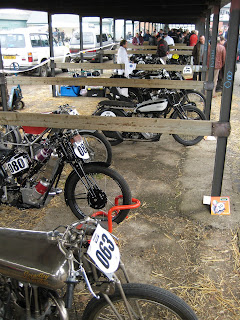
This is the fourth Brooklands event I've attended, and dwarfed all previous with the number of entries and bikes on display, and the crowd milling around. The old motto, 'the Right Crowd and No Crowding' certainly didn't apply on the day, but I didn't mind a bit. It was all crackling noise and excitement from the moment Dai pulled the car into the lot, very early in the morning. Someone was firing up an alcohol-burning veteran in the parking area, with all attendant smoking and noise. We got distracted at the entry by the autojumble stalls, especially a scrapbook of original racing photos from ca 1934-36... lovely to look at, but at £3000, it was waaay out of my league. I'd rather have another motorcycle!

The giant grassy outfield was host to several one-make clubs (Scott, Douglas, Vincent), but the Velocette club dwarfed them all with a huge entry of machines from 1913 - 1971, including the Roarer, and the oldest known Velo of Dave Masters, recently featured in Classic Motorcycle. See photo of Dai sitting on the 1913 Model A Velocette, which was fired up by Tim Simkins, who looks after the two-stroke side of the Velocette Owner's Club. Velo made their early reputation on excellent little 'strokers, before they leapt directly to ohc bikes (the 1926+ K series), and went 'one step back' in '33 with the introduction of the ohv MOV 250cc. Their last tw0-stroke was the GTP of 1948 - I used to own one, and it was a lovely little bike, but too slow for my tastes! See movie of the Model A being fired up... with a kiss to the petrol tank!

Graham Rhodes was tending the Roarer, which everyone was hoping would be fired up, but this wasn't to be as Ivan was busy, and Graham is unable to ride since his 2005 Manx TT win (he has developed MS). His father Ivan raced around the grounds on the '26 Alec Bennett TT-winning ohc 350cc K model (pre KTT, this was a hotted up standard roadster). The bike is in original paint and plating, and has a rustic patina for sure, but is all the more compelling for it. See the video of Ivan not slacking up the Test Hill. He has been racing old Velocettes since they were barely old at all!

I'll have to make another post with more individual bike photos, as there were so many unique or very rare machines being ridden around. Several collectors brought out their best hidden gems, including a New Imperial 250cc with a LeVack-created dohc JAP engine - one of 6 built. This same fellow has two of the six Sunbeam Crocodiles built in 1926, and was kind enough to let me sit astride what is, for me, a personal dream machine; no I didn't make brrrb brrrb noises. I had actually arranged to meet this fellow beforehand, as we have a mutual friend, and he graciously invited me to visit his collection in Austria (subject of another post!). The Crocodile is called thus as, like the Croc in Peter Pan, it goes 'tick tock', unlike the traditional silence of the ohv and sv Sunbeams. A close look at the bike reveals the cylinder barrel which is cast for an ohv machine, and still has the indents for the two pushrods. Clearly, not ready for production - all these ohc 'Beams were factory experiments, which they dropped when performance proved disappointing (they didn't use a strobe light to see how the valves were bouncing around with different cam shapes - that took Harold Willis of Velocette to sort out).

There were racing Douglas' from the 20's which ranged from scruffy and original to ultra-resplendent in nickel plating and silver/blue paint schemes. The sounded phenomenal, and looked so fast just sitting there. Each of them seemed to be different as well, with changes to carbs, airboxes, wheels, tanks, etc, even though they were from the same small factory, and within perhaps only 4 years of production range, 1925-29.

Chris Illman, whose Norton-JAP sprinter was featured in an earlier post, brought along some of his 'gear' (knowing how much I like Really Cool Gear) - here's a photo of a watch which was presented to Freddy Dixon, after winning 4 classes at a race meeting in 1921, on his Harley-Davisdon. He got the watch on ebay, and was I kicking myself while vowing to find a search engine for ebay Brooklands stuff? He also has a copy of my favorite book in the world, Joe Bayley's 'The Vintage Years at Brooklands", which was the personal copy of Dr Bayley, and was signed by all the surviving racers who he mentions in the book. Now, I believe there is only one left, featured in my previous post on Dennis Loveday.


George Cohen showed up with his vintage Norton equipe, a camper truck with a host of really good racing bikes, ranging from early 20's sidevalvers, to late prewar ohc Model 30M. He's pictured astride his latest creation, a flat-tank special Model 18, which is a mix of old and new parts, including new alloy tanks and a freshly made frame. He's almost finished the detail work, and thinks it should do 100mph on the road. "After all, if Rex Judd can do 100mph for an hour on his in 1924, I should be able to as well..." Go George Go!

I heard a rumor that the fellow in the vintage tweed suit pictured near the Roarer, is the grandson of Locke, who built Brooklands in 1907; can anyone confirm this? We spoke of course about vintage clothing and period-correct clothing, as the and the ladies pictured are part of an 'art deco' society which has gatherings totally in time-specific dress. Check out this video of one of their gatherings at an estate in England. It's almost totally perfect, bar one or two things, like modern spectactles and the odd digital camera or cell phone!

Enjoy the rest of these atmospheric photos; if you've never been to Brooklands, and are interested in older racing motorcycles, I can't recommend it strongly enough.




Tuesday, March 11, 2008

Brooklands History in Postcards


Dai sent me scans of some old postcards depicting Brooklands in use and under construction. You'll have to click on them for a better look, but they show very early scenes of the racetrack. The top photo shows the bridge near the Test Hill, which is still extant, and the cars look like 'teens models to me - they aren't going fast enough to utilize the banking.

When the course was built in 1907 by Hugh Locke-King (on his own property, using his own money), the speeds possible for cars and motorcycles would barely top 60-70mph, not enough to justify the near-vertical banking at the top of the track. Clearly someone envisioned higher speeds necessitating the banks - it took until 1913 for a car to reach 100mph on the track, and 1921 for a motorcycle. Too bad they hadn't built the track in a manner to ensure it remained smooth - the track was notoriously bumpy on the joins between the concrete paving. There is a good timeline on the construction and history of Brooklands here.
The second photo shows the Clubhouse with its charming green bell-dome, which now holds a museum and the offices of the Brooklands Society. Those low lean-to sheds to the left of the clubhouse are surprisingly still there as well, and now shelter racing cars before they enter the track on demonstration days. Third photo shows the 'public enclosure', which nowadays is overgrown or built over with new construction. If you click on the pic, you'll see the Victorian outfits (those hats!) and a sporting runabout parked on the grass. Anyone for a picnic? By 1909, an aerodrome was built in the middle of the track, but I don't see it these color postcards, so they must be ca. 1908 - certainly they're pre-WW1. The trees have grown considerably since then as well, and now a shiny Mercedes Benz delivery center/test track sits across the river, just behind the Clubhouse, which would sit right between those two trees.

The construction of the track was a feat in itself, as the banking was created by moving earth to create huge berms 30' high. The concrete track is 100' wide, and the circuit was ~2.8 miles long; all this cost £150,000, representing an enormous sum in those days. The bottom 3 postcards show the method of constructing the banking and laying the concrete, which was mostly done by hand, although a small railway was installed temporarily to help remove or create earthen hills. Clearly the name 'Brooklands' hadn't been applied to the nascent circuit, as it's still called 'Weybridge Motor Track' in these 1906 postcards. (As an aside, these photos look incredibly bleak to me, as do many from the turn of the century - is it the muddy hard work and animal smells which show through, or crude photographic composition, or?).


All this is in total contrast to the construction of the Montlhery circuit in France, which rivalled Brooklands for speed events. Montlherys is an engineered concrete and steel structure - no earthen banks, just a lot of reinforced concrete beams and posts holding up the banking (ah, another post subject). Not enough of Brooklands remains to give a riding impression, but I've ridden the Montlhery banking at speed on a mkVIII KTT, and I'll write about that another time.

The bottom photo was recently sent to me, showing some of the serious horsepower used to haul material and grade the banking here as the Railway Straight. This part of the track, while badly decomposing and covered in moss, can still be seen across the road from a new shopping mall in Byfleet.


And here, for a bit of contrast, is a modern simulator of the Brooklands track, which gives a decent idea of a lap of the Outer Circuit, ca. 1930's. The sound isn't nice, and needs to be changed to a basso profundo
v-twin!

Tuesday, February 12, 2008

Dennis Loveday


In my previous post on David Vincent, I couldn't recall the name of the 'other' Gold Star winner at the Brooklands Velocette Centenary in 2005. Dai asked Michael Sands, who filled us in on Dennis Loveday's background. Here is Michael:

"The Gold Star holder to whom you refer is Dennis Loveday who won his Gold Star on a Velocette, although most of his Brooklands racing was on Ariels. Denis told me that one of his techniques was 'grass cutting'. He said, 'If I could keep as near the bottom of the track as possible, I would be going round a smaller route than those riding way up on the banking, so I might save a bit of time and that meant that some of the time I had my elbow in the weeks. I fitted a pair of bicycle drop-handlebars to get lower [note -see top photo of 'getting lower'!] and one time Noel Pope said to me, 'That looks a bit agricultural' (meaning the Ariel) but I beat him in one race and he never forgave me!'
"Dennis is now a very keen carp angler and although he cannot see the float on his line, he has an electronic bite detector so he can fish day or night. He is still driving short journeys on very familiar local roads because his sight is too poor for general driving....so just beware if you are on the road in south-east Devon!!"


I found some great photographs in 'A Clubman at Brooklands' (AC Perryman, Haynes, 1979), where Dennis is mentioned ten times.
Top two pix show Dennis on his mkI KTT Velo, during the Brooklands Clubman Junior GP, August 31st 1935 - which he won. Bottom photo shows, l to r, Dennis, John Bottomley, Paul d'Orleans, David Vincent.