
 Posts
Posts


Triumph is recalling certain model year 2010 Thunderbird and Thunderbird ABS motorcycles manufactured from September 2009 through August 2010.
These motorcycles were built with an incompatible thread locker/screw combination at the front fender mounting.
The number of units affected is 1955.
Check out my Motorcycle Recalls feature for more details.
Showing posts with label Triumph. Show all posts
Showing posts with label Triumph. Show all posts
Saturday, May 14, 2011
Friday, February 11, 2011
BEFORE THE 'BANDIT'

After legendary Triumph boss Edward Turner retired from the motorcycle factory in 1963, he holed up in a BSA subsidiary, CarBodies Ltd of Coventry, and simply couldn't keep his hand out of the old business. Having entered the hallowed pantheon of Motorcycle Greats with his popular, stylish, and sometimes avant-garde machines from the 1920s onwards, he is best remembered as the man who made a parallel-twin engine look like a twin-exhaust-port single cylinder machine (the 500cc Speed Twin of 1938), which fit snugly into the existing 'Tiger 90' (a beauty as well) single-cylinder chassis. This new combination had magic in name, looks, and performance, and set the tone for the British motorcycle industry for the nearly 50 years, for better or worse (worse at the end!).


 |
| Turner with his 650cc Triumph engine, ca.1960 |

 |
| The radical 1930 Ariel 'Square Four' ohc 500cc engine |


 |
| Wesley Wall of the NMM staff tests the prototype. |
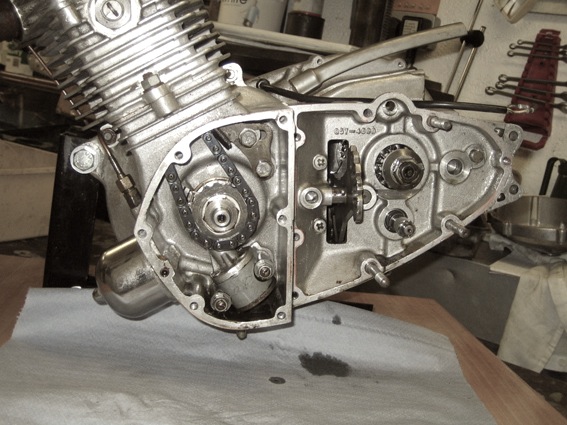 |
| Chain-driven camshaft drive... |
 |
| Pull the pin, lad, and it'll shortly explode... |
Many thanks to Mick Duckworth for forwarding these photos and information about the prototype!
Sunday, December 26, 2010
Triumph Recalls 2010 GT and ST Motorcycles for Incorrect Dipstick Length
Triumph is recalling certain model year 2010 GT and ST motorcycles.
The plug/dipstick is of an incorrect length. As a result, the accuracy of the dipstick for measuring adequate levels of oil may be compromised and adequate oil levels may not be maintained.
The number of units affected is 216.
Check out my Motorcycle Recalls feature for more details.
The plug/dipstick is of an incorrect length. As a result, the accuracy of the dipstick for measuring adequate levels of oil may be compromised and adequate oil levels may not be maintained.
The number of units affected is 216.
Check out my Motorcycle Recalls feature for more details.
Saturday, August 28, 2010
Motorcycle Pictures of the Week - Ken
 Here are my Pictures of the Week as displayed on the Motorcycle Views Website. These are taken from the Moto Pic Gallery. See Ken with his 2009 Triumph Speedmaster. We need more pictures of men and women with their motorcycles. Get your picture in. For details, see Motorcycle Pictures of the Week.
If you'd like to see your bike as Picture of the Week, submit a picture of you and your bike along with a description of the bike.
Thursday, May 6, 2010
TIME WARP TIGER 100 ON SALE AT QUAIL

While the rest of the world was busy hacking itself to bits in 1940, American motorcycle 'Class C' racing carried on until deep in 1942 while we distracted ourselves from joining the fray. While England and the Triumph factory specifically were occupied with military production, the lure of cash from abroad for a special racing model must have been impossible to resist. Plus, helping competitors abroad was not yet forbidden, and the Competition Department surely relished the chance to build one last racing machine before the grim reality of a new war in Europe took hold.

Thus in March of 1940, Rody Rodenberg, a well-known racer from Indiana, ordered a new 500cc Tiger 100 to full racing specification from the Triumph factory, which was to include open megaphones, rearset footrests, a BTH racing magneto, a TT carb with rubber-mounted remote float, 8:1 compression pistons, a bronze cylinder head, and a specially-tuned motor 'guaranteed to provide 120mph top speed'. Destined for 'Class C' (production) racing and an eye to the high speed beach race at Daytona, political events finally caught up with the Triumph, and it sat out the war in Rodenberg's garage.

When officially sanctioned racing resumed in 1947, the Tiger was finally raced at Daytona by Lowell Rettinger, who went on to win the Peoria TT on the machine that year. Rodenberg used the Triumph at Daytona in 1948, and it won a 5-Mile national race at Iowa City in 1951. It appears the Tiger was put away shortly afterwards and simply preserved unscathed, for it remains in exactly as it finished its last race, in remarkably original condition.

How do we know the history of the Tiger? All of the correspondence between Rodenberg and Triumph have been retained with the racer, and are included with the machine in its sale at Bonhams on May 8th, at the Quail Motorcycle Gathering. Factory prepared racing Triumph twins are rare, period, as Edward Turner was no fan of risking the factory's reputation on events as uncontrollable as a motorcycle race. A factory tuned pre-war Tiger 100 with full documentation is even more unusual. That it exists in such a beautiful state today is exceptional, and probably unique. I envy the new owner!


If you're interested in more details on this machine, I have scans of all the factory correspondence.
Wednesday, December 16, 2009
TRIUMPH ILLUSTRATION MYSTERY
 I love when readers pose a question I can't answer; I get to throw it out to the world. Have you ever seen this Triumph design before? Amazing... I have no doubt I'll shortly receive a photo of a tattoo with this image!
Here is the query:
"Hey Paul,
My name is Brian, from Brooklyn, NY. Been checking out your blog for some time now and have become quite a fan; great way to kill a few minutes when I really should be working. [FYI - readership spikes during business hours! You're not alone Brian].
Your wealth of knowledge on old bikes is astounding. I have been tinkering around with Triumphs for years now and have been to my share of swaps etc., recently came across a bowling style shirt with an unusual design. I was wondering if you have ever seen one of these before? I realize there are thousands of Triumph t-shirt designs circulating around the world. This seems a little different in that someone took the time and expense to embroider it onto a rather smart looking bowling shirt? Most of these shirts have company names i.e. "Joe's Welding" or whatever on the back to represent the team. Is this possibly a team shirt from Triumph worker's bowling team? Seems far fetched but I have never seen this skull/unit motor design before. Just wondering if there might be something else to it. Any info would be greatly appreciated.
Thanks man, Brian K."
Your wealth of knowledge on old bikes is astounding. I have been tinkering around with Triumphs for years now and have been to my share of swaps etc., recently came across a bowling style shirt with an unusual design. I was wondering if you have ever seen one of these before? I realize there are thousands of Triumph t-shirt designs circulating around the world. This seems a little different in that someone took the time and expense to embroider it onto a rather smart looking bowling shirt? Most of these shirts have company names i.e. "Joe's Welding" or whatever on the back to represent the team. Is this possibly a team shirt from Triumph worker's bowling team? Seems far fetched but I have never seen this skull/unit motor design before. Just wondering if there might be something else to it. Any info would be greatly appreciated.
Thanks man, Brian K."
Wednesday, October 7, 2009
Triumph Recalls 2005-2009 Sprint ST for Suspension Problem
Triumph is recalling certain model year 2005-2009 Sprint ST1050 motorcycles manufactured from November 4, 2004 through September 2009.
The rear suspension drag link assembly in these motorcycles can fracture due to corrosion.
2849 units are affected.
Check out my Motorcycle Recalls feature for more details.
The rear suspension drag link assembly in these motorcycles can fracture due to corrosion.
2849 units are affected.
Check out my Motorcycle Recalls feature for more details.
Saturday, April 4, 2009
Bridgestone Recalls Exedra G850G Motorcycle Tires for Triumph Rocket III Touring
Bridgestone America's tire operation (Bridgestone) is recalling Bridgestone Exedra G850 G motorcycle tires, size 180/70R16 77H, sold as original equipment for model year 2008 and 2009 Triumph Rocket III Touring motorcycles.
The motorcycle to which these tires are applied develops very high torque and can cause torque-induced degradation in a body ply which may result in innerliner cracking that may lead to a slow leak in the rear tire.
1018 units are affected.
Check out my Motorcycle Recalls feature for more details.
The motorcycle to which these tires are applied develops very high torque and can cause torque-induced degradation in a body ply which may result in innerliner cracking that may lead to a slow leak in the rear tire.
1018 units are affected.
Check out my Motorcycle Recalls feature for more details.
Tuesday, January 20, 2009
HIGHWAY 61 REVISITED...ON A TRIUMPH
 These photos of Bob Dylan date from 1964/5, when he rode a Triumph on the leafy roads surrounding his home in Woodstock, New York. This charming young folk singer, a man of unpredictable habits, was a charismatic figure on his red-and-silver '64 Tiger 100. He was often accompanied by a lovely young lady named Joan Baez, who was his early defender, lover, and co-performer, notably at the August 28, 1963 March on Washington, in which Dr. Martin Luther King, Jr. gave his 'I have a Dream' speech. Dylan's music, implicitly political during this period, became anthemic to a generation seeking change.
The Triumph must have given him a needed break from his resounding fame at the age of 23; we all know the curative effects of a ride through the woods on a scintillating and well-balanced motorcycle. He had recently released his third album, The Times They Are A'Changin', which had gone double Platinum. His second album, Freewheelin Bob Dylan, had gone Platinum, and included the single 'Blowin in the Wind'. His first album, 1962's Bob Dylan, sold a mere 5000 copies. By 1964, many other artists were covering his songs and scoring hits with them as well. During the two years he owned his Tiger, Dylan had recorded four more albums; Another Side of Bob Dylan, Bringing It All Back Home, Highway 61 Revisited, and Blonde on Blonde, all of which went gold, platinum, or double-platinum. Added to the recording dates were incessant US and European tours, appearances, and photo opportunities; a punishing schedule.

On July 29, 1966, it was announced that he had suffered injuries after 'locking up the brakes' on his Tiger 100, not far from his manager Alan Grossman's house in Woodstock. Though no hospital data records an entry from Bob Dylan, he claimed to have suffered facial lacerations and 'several broken vertebrae in his neck'. Quite an injury, yet no ambulance was summoned.
Dylan had this to say about his crash: "When I had that motorcycle accident ... I woke up and caught my senses, I realized that I was just workin' for all these leeches. And I didn't want to do that. Plus, I had a family and I just wanted to see my kids." (Cott, Dylan on Dylan, 2006) In the months after his 'accident', Bob Dylan withdrew from what had been a frenetic touring, recording, and appearance schedule, and didn't play much in public for 8 long years. His music became more personal, less political, as he explored blues and country music in later years, much to the chagrin of his fans. Nowadays he rejects political interpretations of his lyrics, but his presence at events like the March on Washington tell a different story.

He certainly cut a stylish figure on his Triumph, although it's a shame the motorcycle took the rap for a man who clearly needed a break. Above is the cover of his 1965 album, Highway 61 Revisited; peeking out from his psychedelic blue satin shirt is a Triumph tee, which surely boosted sales amongst the young and hip. An early example of 'product placement'!
Thursday, January 15, 2009
50 YEARS OF BONNIE
 It seems almost incomprehensible that the old girl turned 50 this year, but Bonnie, who slipped out of sight for a few years, is yet running wild on the streets, and although she's gained a bit of weight (and haven't we all), her wasp waist still turns heads.
Conceived to tame the hunger from the American market for bigger and faster motorcycles, the addition of a twin-carburettor cylinder head to the Tiger 110 model proved to be a resounding success. The timing was perfect; Texan Johnny Allen had just taken (in 1956) his streamlined T110-powered cigar to the Salt Flats of Bonneville, and claimed the World Motorcycle Speed Record at 214 mph. The machine was unsupercharged, and used a surprising number of 'standard' components - including the engine, gearbox, and wheels, although it drank a bit of nitromethane to compensate for the thin air of Utah's high desert.

Edward Turner, Managing Director of Triumph, certainly knew how to capitalize on a bit of free press, and after a publicity tour in England for Allen's streamliner (see it on BBC TV!) christened his new design after the location of this latest triumph. True, he did a bit of legal tippy-toes to keep lawyers from General Motors from scotching the whole project, but the name stuck fast, entirely eclipsing the now-humbled Tiger from which it sprang.

There were other changes within the Bonneville; the legendary E3134 racing camshafts, higher compression pistons, a stronger clutch, and a few other details, giving a theoretical top speed of 120mph (hence the official 'T120' designation) but the twin carb addition was enough to completely differentiate the new model from anything else in the Triumph lineup.

And line up they did; when introduced in 1958 at the Earl's Court Show, there was a great clamor for the machine at home, before it ever reached its intended target, the USA. Britain was still under the edict 'Export or Die', as the country was hobbled by debt from WW2, and needed import cash from abroad, or else. Thus, locals had to wait seemingly forever to see the T120 they had paid a deposit for, while in the US, we were buying them as fast as they were hauled off the boat.

1958 was the very peak of motorcycle sales/production in England, and no Cassandras could see then that the very economic recovery which Triumph were creating in England would prove its ultimate downfall. Motorcycles make excellent commuter and even family vehicles in times of financial duress - great gas mileage, compact size, easy buy-in price - and since the economic crash of 1929, bikes and sidecar sales were mostly for utilitarian purposes. Only the wealthy could afford hot-rod sporting machines of little transport value, at least when transporting a family sidecar. But, as the global economy blossomed in the late 1950's, everyone wanted a car to haul the family around, drive to work, take trips. Motorcycles as utilitarian tools were doomed in the Developed nations, although booms in small utility motorcycles occur in every country like clockwork, once a little money begins to flow; places like Vietnam and Thailand are literally overrun with mopeds and small motorbikes, and it is the Honda Cub which prevails, like the cockroach.

But for quite a few years, the Bonneville was THE glamour machine, and acquitted itself very well in all sorts of venues, from converted military airfields like Thruxton, to the harsh desert sands of Southern California. Some would argue that the Norton 650ss was a better race bike, or the BSA Gold Star was the better dirt bike, but as an all-arounder, it was hard to beat a 404lb motorcycle with 42hp and nimble handling. Yes, you might well encounter weaves at very high speed, but victories in scores of production and endurance races in the 1950's thru 70's should silence critics of Triumph handling forever. They handle just fine, thank you.

The first major change to the T120 came in 1962, when the engine was totally redesigned to follow its smaller brother the T100 into unit-construction, making for a more compact power unit and slightly shorter chassis. The 'look' changed too, gaining a lean yet graceful stance. Power hovered around the same figure for the entire 650cc production series (1959 - 1974). Detail changes included the shape and size of the petrol tank (it tended to get smaller until '73), the shape of the chrome 'Triumph' badge from the early 'mouth organ' to the later 'eyebrow' design, and the design of wheel hubs and brakes. The 1960s were the 'classic' years of the Bonnie, when the look became entrenched in our consciousness, and many consider the 1969 and 1970 models the very best.

1969 was arguably the Bonnie's finest year; Malcolm Uphill became the first rider to lap the Isle of Man at 100mph on a production machine, in the Production TT, and T120 riders were also 3rd, 5th, and 6th. Further victories were scored in the Barcelona 24-hr, Swedish GP, and Thruxton 500-mile GP, with Bonnies taking 2nd, 5th, 6th, and 7th places - a sweep.

The Swinging 60's were a period of great profitability and success at Triumph, and their Board were not immune to the temptations of the era. What I am trying to say is, they must have been on drugs to redesign the chassis for the 1971 model, the first oil-in-frame Triumph. The concept was sound, but the execution was troublesome from the very beginning. Cash was shovelled into Umberslade Hall, the new design center for the now-merged BSA/Triumph concern, which assumed control of all drawings for a 'new' range of badge-engineered Tribsas.

The results of their mammoth ineptitude was a 3 month stretch when no motorcycles were produced, and the fully-paid workforce passed the days playing chess on packing cases! The new computer-generated frame was touted as the future of motorcycle design, which it was, but the 'Future' always comes with growing pains, and nobody seemed to notice that the new seat height of 32" destroyed much of the grace and nimble feel of the original Bonnie. There was also the small matter that the engine would not fit into the frame as drawn. Three frame changes during the year were necessary, by which time (July 31st, 1971) the official deficit of the company was £25m.

1973 brought the 750cc T140 Bonneville, which had little extra power but quite a bit more oomph in the midrange, all in an idential chassis. The T120 ran beside it for two more years, although given the option of a larger engine, buyers voted with their pocketbooks. Still, the calamity which was the BSA Group meant that urgent financial action was necessary, and in stepped Dennis Poore to merge his existing motorcycle concerns with Triumph (letting BSA fall into the void), thus Norton-Villiers-Triumph (NVT Ltd.) was born.

But NVT's relationship with the Bonneville was short-lived; on Fri. Sep 14 1973, the practical decision was taken by NVT to close the Meriden factory where Triumph had made every Bonnie, and move production to Kitts Green, under a rationalization of production with their other lines. To a man, the shocked Triumph workers seized the Meriden factory, closing out management completely until Mar. 6 1975. Negotiations with a sympathetic Labour government brought life in the form of loans to the newly created Meriden Co-op, which began making the Bonneville again immediately, now with a left-foot shift, in accord with US laws.

The Meriden Co-op struggled along until 1983, introducing model changes annually, including an electric start in '80, disc brakes, 5 speed gearboxes, even an 8-valve cylinder head based on the Weslake aftermarket design, the 'TSS' model, the workers' swan song. With no real money to develop the range, and dwindling sales from an ancient design, the end was at hand.

John Bloor purchased the Triumph name, and what he could of the original Meriden factory in 1984, and production moved to Newton Abbot, with L.F. Harris Ltd making the 'old style' Bonnie under license from Mr. Bloor. It took almost two years for another Bonnie to roll out of the new factory, and the design was much as Edward Turner had laid down on paper, a continuation of the last Meriden machines. These 'Harris' Bonnevilles were produced for the emerging 'classics' market, in small numbers, and with few changes barring the use of Paoli Italian forks. Production of Turner's Bonneville ceased in 1988.

But Bloor had much bigger plans, which didn't include the 50 year old engine design. Using his personal fortune, he purchased land in Hinckley to create a new factory, and invested an estimated £60m creating a wholly new Triumph line of modern layout and performance. The fruit of his investment was born in 1989 with a totally new range of three and four-cylinder dohc machines. With a modern approach and a new factory, Triumph managed to thrive in a difficult market by making canny choices, and choosing its battles wisely. Reputedly, 13 years elapsed from that initial investment before a profit was realized - such are the deep pockets necessary these days to create a successful new motorcycle line.

In 2000, after a gap of 12 years, a new Bonneville was launched, with styling harking back to the 1960s models, but with a new dohc 800cc twin-cylinder engine, and of course a completely modern chassis. 9 years later, it remains one of Triumph's most popular models, as like the original, it's a good all-rounder, and a comfortably sized machine.

Happy 50th birthday, Bonnie!
Saturday, December 27, 2008
Triumph Recalls 2008 Rocket III Touring Motorcycle for Pannier Rail Weld Defect
Triumph has issued a recall of certain 2008 Rocket III Touring motorcycles.
There could be a missing weld on the back of the pannier rail. The pannier rail may, after time, be weakened leading to a full fracture of the rail and possible loss of pannier and rail from the motorcycle, increasing the risk of a crash.
8 units are affected.
Check out my Motorcycle Recalls feature for more details.
There could be a missing weld on the back of the pannier rail. The pannier rail may, after time, be weakened leading to a full fracture of the rail and possible loss of pannier and rail from the motorcycle, increasing the risk of a crash.
8 units are affected.
Check out my Motorcycle Recalls feature for more details.
Saturday, December 6, 2008
Triumph Recalls 2008-2009 Thruxton for Brake Caliper Defect
Triumph has issued a recall of certain 2008-2009 Thruxton motorcycles.
The installed front brake caliper bracket bolts may be too short, reducing thread engagement of the bolts into the brake caliper bracket.
87 units are affected.
Check out my Motorcycle Recalls feature for more details.
The installed front brake caliper bracket bolts may be too short, reducing thread engagement of the bolts into the brake caliper bracket.
87 units are affected.
Check out my Motorcycle Recalls feature for more details.
Thursday, October 16, 2008
HAPPY ANNIVERSARY IVAN

Okay I'm a few days late, but Motoring George Spauwen, a Dutch Vintage Motorcycle Association member (and prewar Triumph twin fanatic), sent a timely note reminding me that on October 8, 1938, Ivan Wicksteed used his supercharged Triumph Speed Twin to take the Brooklands Outer Circuit lap record at 118.02mph. That's really going some for the early six-stud Triumph engine, and I know there were troubles encountered with 'total cylinder filling', mainly with the barrels pulling completely off the crankcases due to the inadequate clamping of six little studs. The barrels were soon changed to an 8-stud design, which stood Triumph twins in good stead for decades.
Wicksteed began racing at Brooklands in 1934, using a 350cc Cotton-Blackburne, but was disappointed that he could only reach 76.61mph on the flying kilo; not enough for an ambitious speedman. He sold the Cotton and bought a Rudge, replacing its engine with a JAP racing ohv. By 1936, he had moved up to a 500cc Excelsior, and gained his Gold Star with a lap of 101.64mph. He also sprinted an Excelsior 'Mechanical Marvel' 250cc ohc at the likes of Gatwick.

In 1937, he switched to racing Triumphs, using a single cylinder 500cc machine to raise the fastest 500cc lap to 110.68mph. Later in the year, he acquired a new Speed Twin, which (as mentioned) gave lots of trouble during its development, but Wicksteed carried on and was eventually able to reliably lap Brooklands at 107mph. I note also that Wicksteed competed for the 'Professor A. M. Low Cup' all-comers 3-lap handicap race in '37 (see more about Low in a previous post).
In 1938, he modified his Speed Twin to accept an Arnott supercharger, which brought yet more problems, not only with mechanical reliability, but the handling of the machine seemed to worsen as the speed increased! [It has long been said that Edward Turner, designer of the Triumph Speed Twin, chose his steering head angle for aesthetic appeal, as a more stable but longer steering angle left too much space between the front mudguard and the frame!]

Eventually the blown Triumph had a claimed capability of lapping the course at 122mph, with a top speed of 127mph, and Ivan decided to make his attempt at the 500cc lap record. On October 8, 1938, conditions were poor, with rain and a strong southwesterly wind, but the Hutchinson 100 race was likely the last possible venue for his speed record of that year (Brooklands records were generally recorded during a race, unless a long-distance speed attempt was undertaken). He was successful in taking the 500cc lap record at 118.02mph, which brought Mr. Wicksteed immortality, as the record still stands. The track was closed in 1939 for war preparations (with important Vickers avaiation facilities integrated into the circuit), and was too badly damaged during WW2 to reopen postwar.

A reproduction of Wicksteed's machine can be seen in the Brooklands Museum (color photos).
Other photos and information taken from 'All the Years at Brooklands' (Bayley) and 'A Clubman at Brooklands' (Perryman).
Friday, September 19, 2008
Triumph Recalls Sprint ST1050 for Rear Suspension Defect
Triumph has issued a recall of certain 2008 Sprint ST1050 motorcycles.
There is a possibility that the single bolt that is used in the 3 positions on the rear suspension drag link assembly can become brittle and fracture.
372 units are affected.
Check out my Motorcycle Recalls feature for more details.
There is a possibility that the single bolt that is used in the 3 positions on the rear suspension drag link assembly can become brittle and fracture.
372 units are affected.
Check out my Motorcycle Recalls feature for more details.
Sunday, August 10, 2008
SUMMER PICNIC, English Style
 Dave, wanting to prove the English can picnic just as well as the Germans, sent along this photo of a young couple (NO wedding ring on her finger) enjoying nature, or what comes naturally, on their Triumph outfit. I would suggest the model is a 1930 CSD sidevalver of 550cc, which would have set the fellow (and I'm assuming it's his machine, as he's not wearing a white dress) back £39.17.6, plus the sidecar... a bargain machine, slow but reliable, and able to haul the chair, the girl, and the gear, much more comfortably than the little BMW single in the previous picnic post. Plus, with a sidecar, you can haul a hand-crank gramophone and a few 78's to increase the romantic mood... never mind that the pot to boil your tea fell of the 'chair' and now looks distinctly secondhand. Given the apples and cheese strewn about, it looks like they've already had a bit of a tussle...and I'm beginning to wonder if these were 'naughty' postcards, rather than factory advert photos.
And a note about the sorry state of Triumph literature; 'how could this be', you might ask, 'there are dozens of books about Triumphs', which is true, but the coverage of anything prior to Edward Turner's input (the 'Tiger' 70/80/90/100 and Speed Twin), is sparse and poorly researched, and the photographic stock is even worse. I've got all the Triumph books, but had to pull out a 'Show' issue of The Motorcycle from 1930 to find our model here. There is a recent history of New Imperial motorcycles which has every model described and photographed from catalogs or contemporary press - now that's helpful. Definitely a publishing opportunity for a Triumph fanatic.
Thursday, July 17, 2008
Triumph Recalls 2008 Speed Triple for Handlebar Riser Defect
Triumph is recalling certain 2008 Speed Triple motorcycles.
Due to improper machining of the handlebar riser, the handlebar may slip in the clamps. This slippage could cause a loss of control of the motorcycle increasing the risk of a crash.
93 units are affected.
Check out my Motorcycle Recalls feature for more details.
Due to improper machining of the handlebar riser, the handlebar may slip in the clamps. This slippage could cause a loss of control of the motorcycle increasing the risk of a crash.
93 units are affected.
Check out my Motorcycle Recalls feature for more details.
Thursday, April 3, 2008
Triumph Recalls Rocket III Touring Motorcycles for Label Misstatements
Triumph has issued a recall of certain 2008 Rocket III Touring motorcycles.
These motorcycles fail to comply with the requirements of Federal Motor Vehicle Safety Standard No. 120, "Tire Selection and Rims for Motor Vehicles Other Than Passenger Cars," and Part 567, "Certification." The certification label, located on the left front frame tube, includes incorrect information regarding tire sizes and pressures, as well as an incorrect Gross Vehicle Weight Rating (GVWR). An owner may under-inflate the front tire if using the incorrect information. Under-inflation may cause a tire to slip or come off the rim causing a loss of control which could result in a crash.
356 units are affected.
Check out my Motorcycle Recalls feature for more details.
These motorcycles fail to comply with the requirements of Federal Motor Vehicle Safety Standard No. 120, "Tire Selection and Rims for Motor Vehicles Other Than Passenger Cars," and Part 567, "Certification." The certification label, located on the left front frame tube, includes incorrect information regarding tire sizes and pressures, as well as an incorrect Gross Vehicle Weight Rating (GVWR). An owner may under-inflate the front tire if using the incorrect information. Under-inflation may cause a tire to slip or come off the rim causing a loss of control which could result in a crash.
356 units are affected.
Check out my Motorcycle Recalls feature for more details.
Thursday, March 13, 2008
Triumph Recalls Speed Triple for Rear Suspension Problem
Triumph has issued a recall of certain 2008 Speed Triple motorcycles.
The rear suspension unit (RSU) damping performance is controlled by a mixture of gas and oil contained within the unit. This mixture is kept inside the unit by control oil/gas seals. If the seals become damaged, the mixture will escape. Once the mixture has escaped the RSU, the rear suspension will lose its damping ability. The rear suspension will be controlled only by the action of the coil spring also attached to the RSU.
265 units are affected.
Check out my Motorcycle Recalls feature for more details.
The rear suspension unit (RSU) damping performance is controlled by a mixture of gas and oil contained within the unit. This mixture is kept inside the unit by control oil/gas seals. If the seals become damaged, the mixture will escape. Once the mixture has escaped the RSU, the rear suspension will lose its damping ability. The rear suspension will be controlled only by the action of the coil spring also attached to the RSU.
265 units are affected.
Check out my Motorcycle Recalls feature for more details.
Monday, March 10, 2008
Grandma's Triumph
 Craig Howell, who uploads photos from every vintage motorcycle event in the Bay Area to his website (for example, his page on the 2006 Legend of the Motorcycle), sent me this photo, from a friend's family album.
The woman is Erma Barth (soon to become Schopfer - that's an engagement ring on her finger), and the photo was taken around 1933 near Thale, in the Harz Mountains. March 6th, 2008 would have been her 100th birthday - happy centenary Erma!
The bike is a German Triumph (TWN - Triumph Werke Nuremburg, founded in 1903 as a branch of the English Triumph motorcycle factory; click here for a timeline - TWN became autonomous after the '29 stock market crash) two-stroke, which looks to be mid-20's, and around 250cc. Its small engine capacity hasn't stopped the bike's owner (Erma?) from loading it up with accessories, which include acetylene AND electric lighting (there's a small spotlamp on the handlebars), a motorcycle club pennant, heavy saddlebags, and the biggest passenger seat I've ever seen (which just might be the only comfortable passenger seat for a rigid frame).
What dates the machine to the early/mid 20's are the 'dummy rim' brakes, which supplanted the useless stirrup brakes on Veteran machines (made until 1920), but were themselves superseded by drum brakes starting around 1923/4. The first front drums were tiny, only 4" or 5" in diameter, and were basically decorative. On my 1925 Sunbeam, you can push the machine along with the brakes hard on - I've done this on early Nortons as well.
I'd say that German machines in general were much more robust (read; heavy) than their English counterparts, but of course the Yankee machines topped them all for avoirdupois. I don't know what this says about 'national character', or the quality of the roads in different countries, or perhaps the expectation of durability/longevity of owners.
Erma is wearing an interesting outfit - wool knee breeches and jacket, high stockings with Mary Janes, and an adorable beret. Not especially figure-flattering, but functional, and totally unisex (except for the shoes - only very young boys wore 'Buster Brown' shoes; by the way, Mary Jane was his sister in the comic strip).
Wednesday, December 19, 2007
Triumph Recalls Sprint ST and Tiger for Luggage Rack Problem
Triumph has issued a recall of certain 2004-2008 Tiger and 2005-2008 Sprint ST motorcycles.
On certain motorcycles equipped with an optional accessory luggage rack, undersized washers were used which prevents the sliding carriage from moving as intended. Reduced stability can occur if the motorcycle is ridden with the fitted accessory, exceeded maximum weight, and at speeds far in excess of the 80 mph limit warning, increasing the risk of a crash.
3698 units are affected.
Check out my Motorcycle Recalls feature for more details.
On certain motorcycles equipped with an optional accessory luggage rack, undersized washers were used which prevents the sliding carriage from moving as intended. Reduced stability can occur if the motorcycle is ridden with the fitted accessory, exceeded maximum weight, and at speeds far in excess of the 80 mph limit warning, increasing the risk of a crash.
3698 units are affected.
Check out my Motorcycle Recalls feature for more details.